6 Biggest Mistakes New Sports Photographers Make

When you are first learning a new skill, you are going to make mistakes along the way. It is simply part of the process. But there are some mistakes you can (and should) avoid to help you become a great sports photographer right from the start. These are classic mistakes that many sports photographers make but that can be easily avoided.

sports-photography-mistakes

  1. Reviewing your photos after taking a shot

This is called “chimping” and it is a big no-no for sports photographers. Chimping is when you check every photo you take on your LCD after you’ve taken it. The reason you should not do this in sports photography is that it takes your eyes off the action. You never know what could happen next at a sporting event so you want to ensure you are keeping your eyes on the action! There will be plenty of time to review the photos after the game.

2. Stopping when the whistle blows

Even though the players stop after the whistle blows, it doesn’t mean you need to stop shooting. A central part of sports photography is capturing the story and emotions of the moments and those emotions often come after the play has been made. Keep shooting during time outs or after the action has stopped. You never know what emotion or moment you can capture.

3. Not knowing the venue and the rules of the venue.

It’s always important to be somewhat familiar with the venue of your sporting event and the rules you need to follow while you’re photographing. Depending on the level of the sport, there may be certain areas you can shoot from or certain places you are supposed to stand. You definitely want to be aware of your surroundings and the rules.

4. Using a flash

Flash photography is strictly prohibited. It is incredibly distracting to the athletes and will automatically give you away as a “newbie” photographer. You can adjust your settings to help you brighten up your photos.

Women's Basketball vs Dayton

5. Sticking to one angle

In sports photography, there are many different angles and ways to capture the moment and tell the story of the game. Great sports photographers understand the need to experiment with angles, anticipate action and move throughout the event to show many different aspects of the game.

6. Worrying about getting the perfect shot

It’s easy to do. We all want to capture the best shot of the game but when you worry or try to anticipate the best shot, you might end up missing something spectacular. Stay in the moment and stay in the action and keep shooting. During the editing phase, you can access the results but during the game, have fun, stay in the moment and relax. You will end up having much more fun and probably capturing better photos than if you were worried!

Wrestling vs EdinboroReady to improve your sports photography skills? Sign up for a class with DC Sports Photography Academy! You can choose one game to try it out or book multiple games to really enhance your skills. We offer classes for all levels. Our classes are live college sporting events where you can shoot the game with a professional, learn new skills and capture photos for your portfolio while having a blast! It’s an exciting and one of a kind photography class that you won’t find anywhere else!

If you love photography and want to improve your skills, sign up to receive news and information straight to your inbox:
Enter your email address to subscribe to this blog and receive notifications of new posts by email.

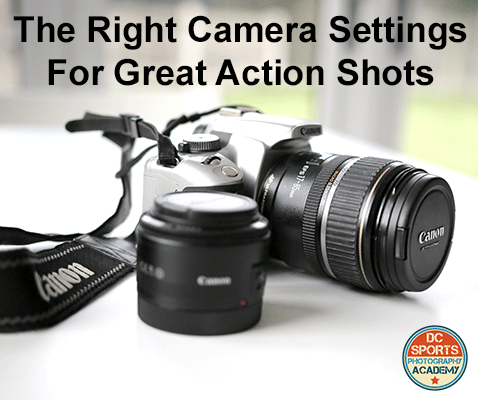
The Right Camera Settings for Great Action Shots

It’s essential that you get yourself set up for success before the action starts in sports photography. Before the starting whistle blows and the game begins, get your camera set up with the right settings so you can shoot like a pro!

right-camera-settings-action-shots

Check your shutter speed and set it to the appropriate speed. Remember this depends on what you are shooting and how fast the subject is moving.

Set your camera to the lowest possible ISO setting for the amount of light you have to work with. If you are shooting outdoors, use ISO 100 or 200. If you are in low light, use higher ISO numbers. It’s important to note that the higher the ISO, the more “noise” or graininess a photo will have. It’s important to find the right balance between noise and blurriness when finding the right ISO setting for your event.

Adjust your aperture. The aperture is the opening of a lens that light passes through and it is calibrated in f/stops. It can be a little bit confusing when you first start off. The lower the f/stop means that the larger the opening in the lens and the higher the f/stop, the smaller the opening. A larger aperture (meaning a lower f/stop) will help you increase your shutter speed and give you a shallower depth of field to help isolate players from the background. This will also help you have a fast enough shutter speed to stop the action.

Try burst or continuous shooting mode. Continuous shooting mode can take multiple shots at a time and can be best for certain types of fast-moving sports. However, remember that your memory card will fill up faster with burst mode so be sure yours has enough capacity or you will have to delete shots at half time or time outs.

If you are shooting an indoor event, you will need to adjust your white balance setting. The preset daylight white balance setting will usually work for outdoor lighting. Because indoor lighting is artificial, you may want to set up a custom white balance or it can impact your camera settings and change the colors of your shot.

You also need to turn your flash off! This is key! Flash photography can distract the players. If you have a slow lens that requires flash, you may want to invest in a faster lens or rent one from DC Sports Photography Academy.

Remember, above all, that sports photography is something that requires consistent practice. Get your settings correct and remember that with each game, you will improve more and more.

Get all of our photography tutorials and resources straight to your inbox.

Enter your email address to subscribe to this blog and receive notifications of new posts by email.

How to Find the Best Camera Equipment for Sports Photography

Sports photography requires you to capture fast-paced action and in order to do that, it is essential you have the right equipment for the job. DC Sports Photography Academy requires its students to use a DSLR camera that allows for the removal of lenses. This allows our students to get the best shots.

If you don’t want to make the investment just yet, we rent professional photography equipment for your classes. But if you are ready to invest in an exceptional camera for your sports photography, this article will give you details on what to look for in a camera.

cameraequipment

A DSLR camera is a digital SLR or single-lens reflex camera. It allows for detachable lenses that deliver precise photos. DSLR cameras are necessary for sports photography because they have faster internal processing so you won’t experience a lag time after you push the button to take your photo. You can capture the moment instantaneously with DSLR cameras. DSLR camera also make it easy for you to shoot many frames for long sequences in a single burst, which is perfect for capturing continuous action. DSLR cameras give you an unparalleled level of control and speed.

Now that you know you want a DSLR, what should you look for in one before your purchase?

There are DSLR cameras available for all skill levels. Be sure to check the sensor size, frames per second and the lens mount so start with. Another feature to look at is maximum ISO for shooting in door or low light action. The higher the ISO you camera is capable of, the more environments you can shoot in.

It’s also important to pay attention to lenses for DSLR cameras. The DSLR gives you the ability to switch lenses, depending on what you are shooting. If you are a beginner sports photographer, you may want to invest in a kit. The kits include both the camera body and a lens. Purchasing a kit can often be a better investment than buying a body and lens separately. More experienced photographers may want to purchase more specialized lenses to help enhance their sports photography skills. The more advanced your photography becomes, the more you will learn about using lenses and choosing the right one for your camera and situation.

You will also want to make sure you have a high capacity memory card and a camera cover in the event of bad weather. As you progress in your sports photography hobby or profession, there will be more extensive lenses and equipment you can purchase. For beginners, finding the right DSLR camera is more than enough to get you started shooting like a sports photography pro!

You can find the best cameras for sports photography online or at an electronics or photography store.

Sign up for photography tips, tricks and resources straight to your inbox!

Enter your email address to subscribe to this blog and receive notifications of new posts by email.

5 Tips For Taking Great Action Photos

Have you ever tried to snap a photo of your child running and it came out blurry? Or you wanted to get a great candid photo but your subjects were moving too quickly? Photographing action is necessary for sports photography but it can be a handy skill no matter what you choose to photograph. Although it may seem impossible to get that perfect action shot at first, we promise that it’s easier than you think! Follow these five tips to start taking fantastic action photos, follow these five tips.

action-photos

  1. Use a faster shutter speed

A fast shutter speed is one of the most important things to capture action shots. The right shutter speed will depend on how fast your subject is moving.  We recommend choosing a shutter speed of  1/400 for indoor motion and 1/1000 for outdoor action and taking some test shots before the action begins to see how sharp your images are. If you notice any blurriness, increase your shutter speed.

2. Find the right vantage point

Vantage point is key for a great action shot. You don’t just want to have a clear view, you also want to have the best vantage point. Consider the different angles of your subjects and how you can best see their reactions and movements.

3. Learn to pan

Panning refers to moving the camera along with the object you are trying to capture. Don’t wait for someone to run past you to catch their photo. Instead turn toward the subject and follow it as it moves past you. This increases your chances of capturing a sharper image. Ensure you have a steady stance and keep your feet firmly planted. Then twist from the waist to follow the movement. When the moment is right, fully press the shutter button.

4. Pay attention to lighting

Lighting can make a big difference in any photo but it can really make a difference in an action photo if you are not paying attention to it. Increasing your ISO can help you in these situations. Raising the ISO can help you to see more light when you shoot at a higher shutter speed. Be careful to test this as if your ISO is too high, the images could appear grainy.

5. Always keep shooting

The one thing you don’t want to miss is the action! Keep your eyes on the action and don’t stop to look at the photos you have already taken. You can do that once the game is over and the action has finished. You could miss a crucial moment and the more shots you take, the more likely you are to capture that perfect action shot.

These five tips will help you improve your action photography skills which can lead to fantastic sports photography or a truly beautiful photo of your child in motion. Whatever your photography goals are, it’s time to practice! Let us know what was the best tip for you and tag us @DCSportsPhotographyAcademy in your Instagram photos so we can see your amazing action shots!

Sign up to receive sports photography tips, tricks and special offers in your inbox!

Enter your email address to subscribe to this blog and receive notifications of new posts by email.